
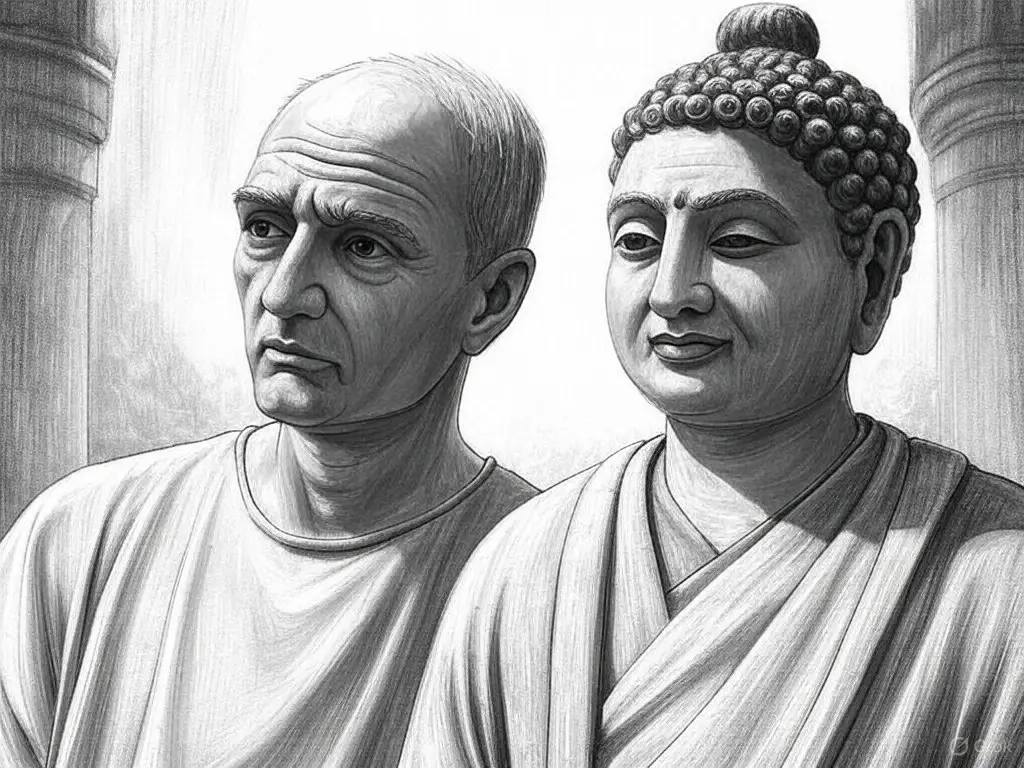
If we set aside the religious aspects of Buddhism—such as reincarnation—we’ll find that there are surprisingly many similarities with Stoicism. In particular, for both Stoicism and Buddhism emphasize the concept of Logos (Viktor Frankl, in his book Man’s Search for Meaning, elaborated on the concept in detail), and stress what individuals can do to improve their lives in pursuit of the ultimate goal: the happiness without the need for any external factors.
I only stumbled upon Stoicism recently—just last year—through a post on the Daily Stoic Instagram account (which I believe is maintained by Ryan Holiday). That sparked my interest, and I began reading more on the subject. My first Stoic book was Meditations by Marcus Aurelius, and it was a delightful surprise. I found so many parallels with the teachings of Buddhism, which I’m more familiar with.

Here are some quotes from Meditations, alongside similar Buddhist texts for comparison between Stoicism and Buddhism . They may not align 100%, but I believe the essence is strikingly close.
Note: Buddhist quotes are highlighted in blue
Book 4, Section 1:
Our inward power, when it obeys nature, reacts to events by accommodating itself to what it faces—to what is possible. It needs no specific material. It pursues its own aims as circumstances allow; it turns obstacles into fuel. As a fire overwhelms what would have quenched a lamp. What’s thrown on top of the conflagration is absorbed, consumed by it—and makes it burn still higher.
“The obstacle is the path.”
Equivalent Quote from Buddhism:
“Those whose defilements are exhausted, who do not cling to food, whose realm is emptiness and sinlessness, liberation—their path cannot be traced, like that of birds in the sky.” – Dhammapada, verse 93
彼等诸漏尽,亦不贪饮食,空无相解脱,是彼所行境,如鸟游虚空,踪迹不可得。- 法句经
Book 4, Section. 24:
“If you seek tranquility, do less.” Or (more accurately) do what’s essential—what the logos of a social being requires, and in the requisite way. Which brings a double satisfaction: to do less, better. Because most of what we say and do is not essential. If you can eliminate it, you’ll have more time, and more tranquillity. Ask yourself at every moment, “Is this necessary?” But we need to eliminate unnecessary assumptions as well. To eliminate the unnecessary actions that follow.
“Do one thing at a time.”
Equivalent Quote from Buddhism:
“When walking, standing, sitting, lying down, waking up, speaking, or being silent, one is fully aware.” – Āgama, sutra 26
行住坐卧,觉寤语默,皆正知之。- 中阿含经
Book 4, Section 43:
Time is a river, a violent current of events, glimpsed once and already carried past us, and another follows and is gone.
“The life of man is of no more duration than the breath of his nostrils.”
Equivalent Quote from Buddhism:
“The Buddha asked the Shramanas, ‘How long is the human life span?’ One Shramana replied, ‘The length of a single breath.’ The Buddha said, ‘Excellent. You have understood the Way.’” – Sutra of Forty-two Chapters, section 38
“佛问沙门:人命长短几何?一沙门答:一息之间。佛言:善哉!汝已得道。” – 佛说四十二章经
Book 5, Section. 33:
Soon you’ll be ashes, or bones. A mere name, at most—and even that is just a sound, an echo. The things we want in life are empty, stale, and trivial. Dogs snarling at each other. Quarreling children—laughing and then bursting into tears a moment later. Trust, shame, justice, truth—“gone from the earth and only found in heaven.”
Why are you still here? Sensory objects are shifting and unstable; our senses dim and easily deceived; the soul itself a decoction of the blood; fame in a world like this is worthless.
—And so?
Wait for it patiently—annihilation or metamorphosis.
—And until that time comes—what?
Honor and revere the gods, treat human beings as they deserve, be tolerant with others and strict with yourself. Remember, nothing belongs to you but your flesh and blood—and nothing else is under your control.
“All things are impermanent, like clouds passing in the sky. Let go of attachments and live fully in this moment.”
Equivalent Quote from Buddhism:
“All conditioned things are impermanent. When one sees this with wisdom, one turns away from suffering.” – Dhammapada, verse 277
一切有为法,皆是无常;当以智慧见此,远离苦难。- 法句经
Book 5, Section 37:
I was once a fortunate man but at some point fortune abandoned me.
But true good fortune is what you make for yourself. Good fortune: good character, good intentions, and good actions.
“Happiness is not found in things outside us, but in the way we see and act in the world.”
Equivalent Quote from Buddhism:
“If one speaks or acts with a pure mind, happiness follows, like a shadow that never leaves,” – Dhammapada, verse 2
若以清净心言语或行动,快乐随之而来,如影随形。- – 法句经
Book 6, Section 31:
Awaken; return to yourself. Now, no longer asleep, knowing they were only dreams, clear-headed again, treat everything around you as a dream.
“Wake up! This world is like a dream, a phantom. Only in realizing this do you find true peace.”
Equivalent Quote from Buddhism:
“All conditioned phenomena are like a dream, an illusion, a bubble, a shadow, like dew or a flash of lightning. This is how you should contemplate them.” – Diamond Sutra
一切有为法,如梦幻泡影,如露亦如电,应作如是观。- 金刚经
Book 6, Section 41:
You take things you don’t control and define them as “good” or “bad.” And so of course when the “bad” things happen, or the “good” ones don’t, you blame the gods and feel hatred for the people responsible—or those you decide to make responsible. Much of our bad behavior stems from trying to apply those criteria. If we limited “good” and “bad” to our own actions, we’d have no call to challenge God, or to treat other people as enemies.
“The mind is the source of happiness and unhappiness. Do not judge or cling to appearances, and you will find peace.”
Equivalent Quote from Buddhism:
“Mind precedes all mental states. Mind is their chief; they are all mind-wrought. If with an impure mind a person speaks or acts, suffering follows him like the wheel that follows the foot of the ox.” – Dhammapada, verse 1
心为法本,心作主宰,心造一切。若以染心言行,苦随其后,如车随牛足 – 法句经
Book 7, Section 26:
When people injure you, ask yourself what good or harm they thought would come of it. If you understand that, you’ll feel sympathy rather than outrage or anger. Your sense of good and evil may be the same as theirs, or near it, in which case you have to excuse them. Or your sense of good and evil may differ from theirs. In which case they’re misguided and deserve your compassion. Is that so hard?
“When you see the fault of others, look within and cultivate compassion. All beings act according to their understanding, and in this, there is no enemy.”
Equivalent Quote from Buddhism:
“One should not seek the faults of others, nor the good and evil done by others. One should only examine one’s own good and evil, what has been done and what has not been done.”- Dhammapada, verse 50
不应求他人之过,不应求他人之善恶。惟当省察己之善恶已作未作。 – 法句经
END.




Leave a Reply