


Renting vs Buying a Factory in Malaysia: How to Decide When Interest Rates Could Rise
Should you rent or buy a factory in Malaysia right now? Between May 2022 and May 2023, Bank Negara raised the OPR five times, from 1.75% to 3.00% (BNM). Every floating-rate factory loan in the country got more expensive.
Today the OPR is 2.75%. BNM cut it on 9 July 2025 and has held it since, including at the 3 September 2026 meeting (BNM Monetary Policy Statement). The next decision is on 5 November 2026 (MPC schedule). Rates aren’t rising now, but no one can promise they’ll stay put.
So treat this as a stress test. Someone always asks: why don’t you just buy? A fairer question is: what happens to that “just buy” if the bank’s rate goes up 1% next year?
Rent vs buy factory Malaysia: why the question feels harder when rates can move
A factory loan to a Sdn Bhd is usually priced off the bank’s Base Rate (BR) or BLR/BFR, plus a spread. The Standardised Base Rate (SBR, 2.75%) applies only to loans to individuals.† BR and BLR follow the OPR, so a floating-rate loan reprices when BNM moves (Maybank base lending rates).
Rent moves too, but usually only at renewal, every two to three years.
The OPR over the last cycle
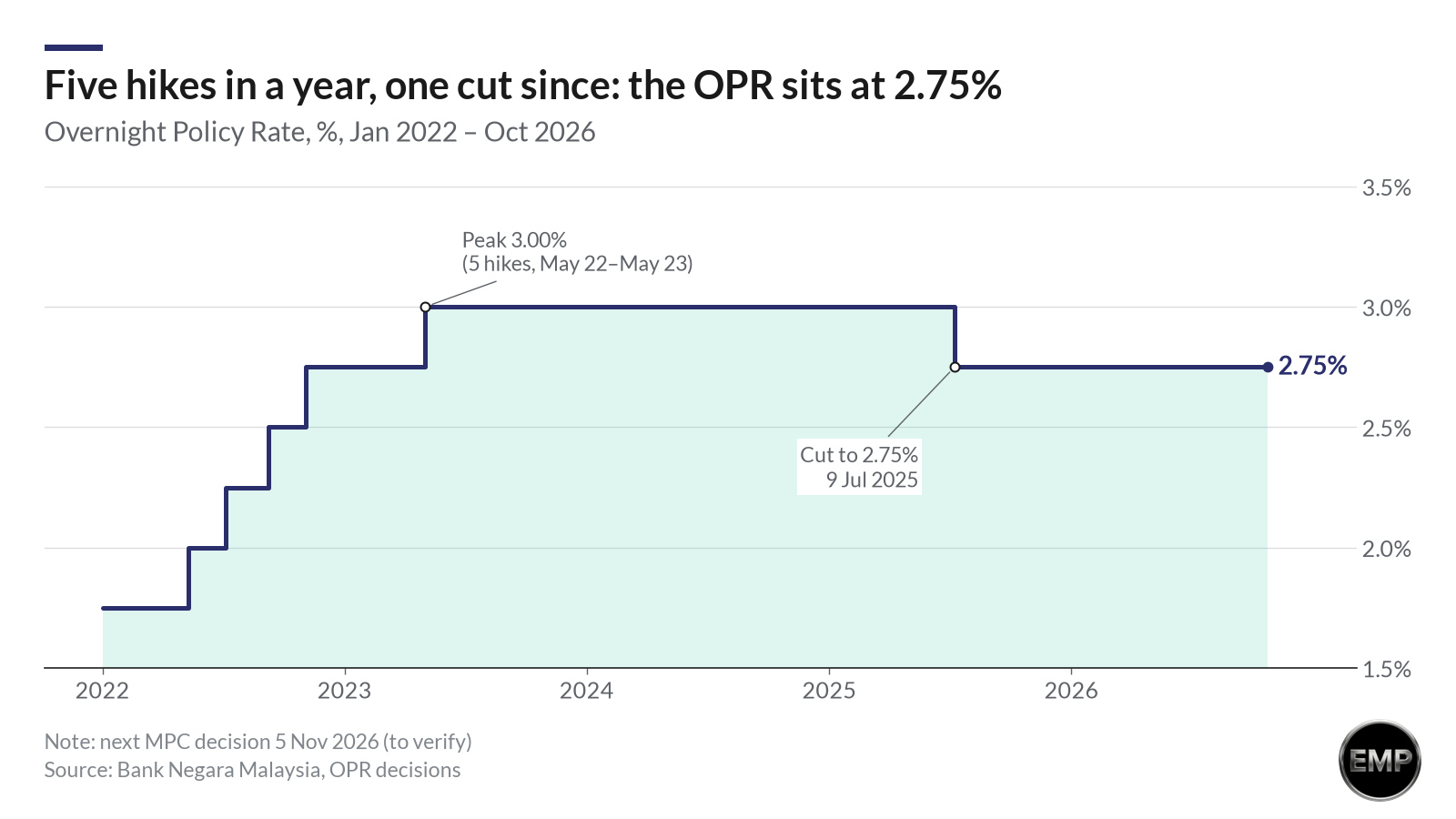
| Date | OPR |
|---|---|
| Jul 2020 | 1.75% |
| May 2022 | 2.00% |
| Jul 2022 | 2.25% |
| Sep 2022 | 2.50% |
| Nov 2022 | 2.75% |
| May 2023 | 3.00% |
| Jul 2025 to now | 2.75% |
Source: BNM – OPR Decisions
Where bank rates sit today
- Maybank’s BR is 2.75% and its BLR 6.40% (effective 11 July 2025) (Maybank).†
- Across ten major banks, BR ranges from 2.75% to 3.75%, and BLR from 6.40% to 6.64%.†
- The average lending rate on outstanding commercial bank loans was 4.55% in July 2026.† Check BNM’s Monthly Highlights and Statistics for the latest figure.
So rates matter. Before we stress-test them, let’s put both options on the table.
What renting a factory really costs you
Rent levels and yields in the Klang Valley
Klang Valley factories give landlords a gross yield of about 5–7%: semi-Ds around 5%, larger properties 7% or more (The Edge).† Prime industrial yields are said to average 5–6% in 2026 (The Edge, 29 Jun 2026).†
Indicative rents are about RM1.50–RM3.00 psf built-up per month, depending on age and spec.† REIT evidence points to about RM1.43 psf (a 2024 leaseback) and RM1.75 psf (2026) per month.† Treat these as a range only.
The hidden costs of renting
- Tenancy stamp duty, about RM2 per RM250 of annual rent for 1–3 year tenancies under the Stamp Act.† See LHDN stamp duty.
- Deposits, typically 2+1 or 3+1 months.†
- Fit-out you leave behind, plus reinstatement when you move out.
- Rent review risk at renewal, and the risk of non-renewal.
What renting gives you
Cash stays in the business. You can move if your contracts change. You carry no property price risk.
Supply may help you too. About 7.2 million sq ft of new warehouse supply is expected in the Klang Valley by end-2026, and occupancy dipped to 96.1% in 1Q 2026 (CBRE-WTW Klang Valley Snapshot 1Q 2026).† That could give tenants more bargaining power.

Now the other side: what it takes to own.
What buying a ready factory really costs you
Day-one cash
Down payment. Banks commonly finance up to 80% for industrial property (The Edge).† Published maximums are 85–90%, and some SME packages that include working capital go to 140–150%; Maybank’s Eco Leap offers “up to 150%” (Maybank Eco Leap).† More margin means more debt, and more debt means each rate rise hurts more.
Stamp duty on the transfer (MOT) under the Stamp Act 1949 (LHDN):†
| Price band | Rate |
|---|---|
| First RM100,000 | 1% |
| Next RM400,000 | 2% |
| Next RM500,000 | 3% |
| Above RM1,000,000 | 4% |
There is no first-home relief on industrial property. Loan stamp duty is 0.5% of the loan.†
Legal fees under the Solicitors’ Remuneration Order 2023 are 1.25% on the first RM500,000, then 1% on the next band, stepping down further on larger amounts.† Our Buy Land to Build Your Factory – Cost Simulator applies this scale.
Other costs: valuation, disbursements, and possibly SST on legal fees (8% since March 2024).†
Monthly and yearly costs of owning
Instalment, quit rent, assessment, fire insurance, repairs, and maintenance or strata charges for strata factories. Our Rent vs Buy a Shop/Factory Simulator lists each one.
Renting vs buying at a glance
| Cost item | Renting | Buying |
|---|---|---|
| Upfront cash | Deposit, typically 2+1 or 3+1 months† | 20%+ down, MOT stamp duty (1–4%), loan stamp duty 0.5%, legal fees (SRO 2023)† |
| Monthly cost | Rent, about RM1.50–RM3.00 psf† | Instalment, quit rent, assessment, fire insurance, repairs |
| Rate sensitivity | Reprices only at renewal (2–3 years) | Floating loan reprices soon after BNM moves; +0.25% ≈ RM140–145/month per RM1m† |
| Stamp duty | About RM2 per RM250 of annual rent (1–3 yr)† | RM184,000 MOT + RM20,000 loan duty on a RM5m example |
| Exit | Reinstatement; non-renewal risk | Company RPGT 30% → 10% from year 6; selling costs |
| Flexibility | High: move if contracts change | Low: capital locked in |
| Upside | Cash kept in the business | Equity build-up and any capital gain |
When you sell: RPGT for companies
For a Malaysian-incorporated company (LHDN – RPGT rates):
| Disposal | Company rate |
|---|---|
| Within 3 years | 30% |
| Year 4 | 20% |
| Year 5 | 15% |
| Year 6 onward | 10% |

Individual citizens pay 0% from year 6 (since 1 January 2022). Most factory buyers are companies, so they pay 10% however long they hold.
Since 1 January 2024, share disposals in a real property company by companies have generally fallen under CGT rather than RPGT (PwC; Deloitte).† Speak to a tax adviser.
Some owners go further and buy land to build. That changes the picture again.
Buying land and building: the third option
Our Buy Land to Build Your Factory – Cost Simulator stacks up every cost: land, construction per sq ft of GFA, external works, consultants, OSC/PBT/IWK contributions, TNB connection at RM45 per kW of maximum demand (substation excluded), 6% SST on construction services, the 0.125% CIDB levy, architect fees (LAM), stamp duties and legal fees.
Watch out for land conversion
If agricultural land must be converted to industrial use (National Land Code s.124), Selangor charges a premium of 20% (light), 25% (medium) or 30% (heavy industry) of the newly approved land value.† Application fees start at RM70, and processing takes about 21 working weeks (PTG Selangor – premium rates; Klang district pamphlet; PTG Selangor – s.124 fees, more).
Buy land that already has an industrial title, or price in the premium and the wait.
The double-payment period
So how much does a rate rise change the maths?
What a rate rise does to your instalment (the stress test)
On a 25-year loan at around 4.5%, each +0.25% adds roughly RM140–145 a month for every RM1 million borrowed.†
We test three scenarios:
- Rates stay (base case)
- +0.50% (two hikes)
- +1.00%, close to 2022–23, when the OPR rose 1.25% in 12 months (BNM)
What about fixed rates?
Fixed-rate packages exist. Maybank’s Maxi Plan advertises “fixed rates as low as 5.20% for the first 3 years” (Maybank Maxi Plan; see also Public Bank SWIFT Plan).† The trade-off: you may pay more upfront for certainty, and the fixed period ends. Check lock-in terms carefully.
Worked example (illustration only): renting vs buying a 10,000 sq ft factory
The assumptions
- A 10,000 sq ft built-up factory at a hypothetical RM5,000,000.
- Rent alternative: RM25,000 a month, a 6% gross yield, inside the 5–7% range above (The Edge).†
- Loan: 80% = RM4,000,000, 25 years, monthly rest.
- Rate: 4.5%, our simulator’s default, close to published illustrations of 4.30–4.44%.†

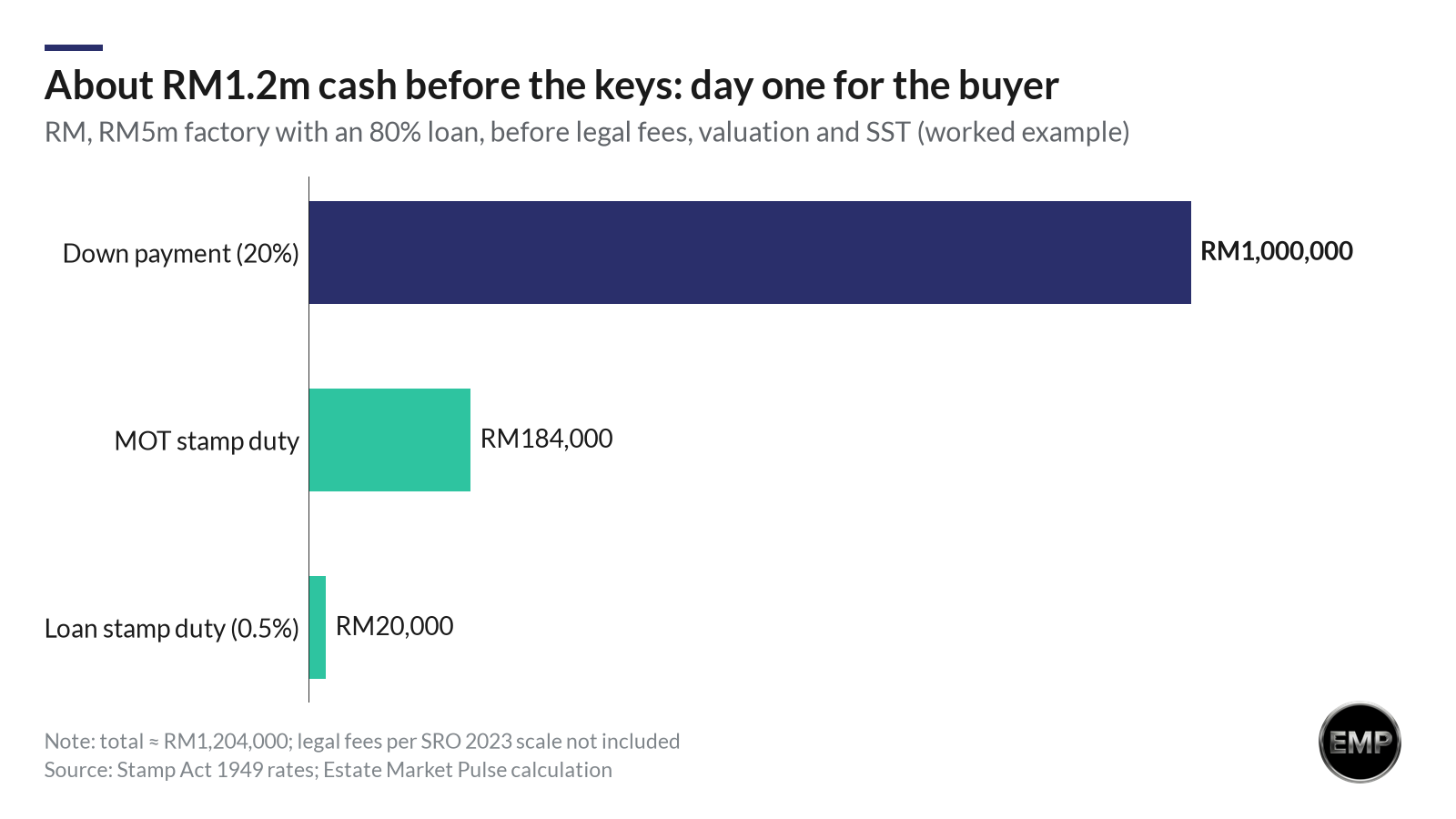
Day-one cash for the buyer
| Item | Calculation | RM |
|---|---|---|
| Down payment | 20% × 5,000,000 | 1,000,000 |
| MOT stamp duty | 1,000 + 8,000 + 15,000 + 4% × 4,000,000 | 184,000 |
| Loan stamp duty | 0.5% × 4,000,000 | 20,000 |
| Legal fees, valuation, SST | Use the simulator (SRO 2023 scale) | † |
| Approx. total before legal fees | ≈1,204,000 |
Monthly instalment on RM4 million over 25 years
| Rate | Instalment / month | vs base |
|---|---|---|
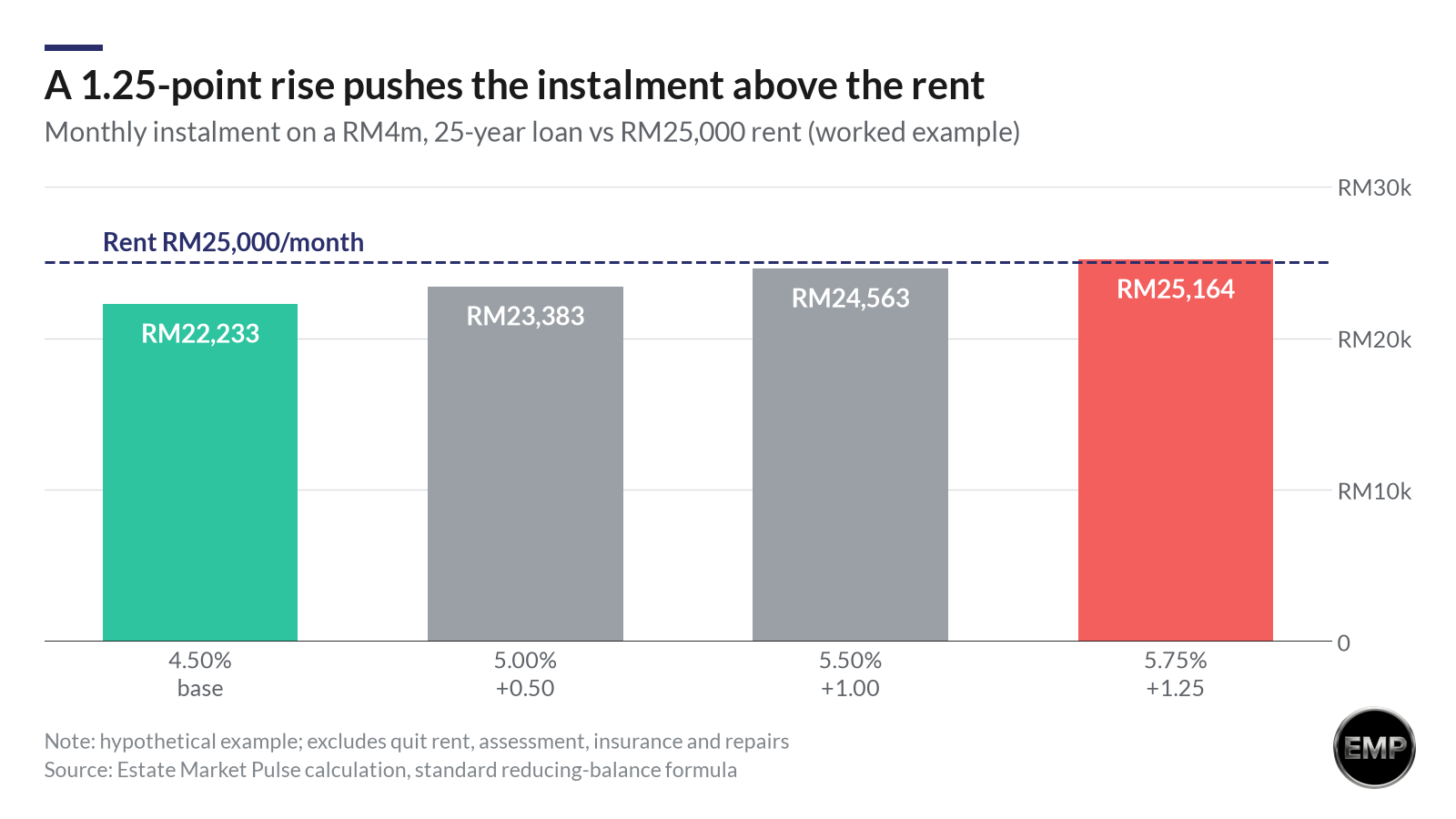
| 4.50% (base) | ≈ RM22,233 | – |
| 5.00% (+0.50) | ≈ RM23,383 | + ≈ RM1,150 |
| 5.50% (+1.00) | ≈ RM24,563 | + ≈ RM2,330 |
| 5.75% (+1.25, 2022–23 style) | ≈ RM25,164 | + ≈ RM2,931 |
Standard reducing-balance calculation.† Recheck in the simulator with your own quote.
How to read it
- At 4.5%, the instalment (≈RM22,200) is below the rent, and part of it builds equity. Buying looks good if you can afford about RM1.2 million upfront and stay six years or more.
- At +1.25%, the instalment roughly equals the rent before quit rent, assessment, insurance and repairs. The buyer now pays more each month and has RM1.2 million locked in.
- The renter’s edge: that RM1.2 million, kept in the business or invested at the 6.5% opportunity cost in our Rent vs Buy simulator, earns about RM78,000 a year.
- At exit: a company selling in year 6 or later pays 10% RPGT on the gain (LHDN), plus selling costs (the simulator’s default is 2.5%).
If you plan to build instead
Get your all-in cost from the Buy Land to Build Your Factory – Cost Simulator, then enter it as the “purchase price” in the Rent vs Buy simulator. Add the rent you’ll keep paying plus interest during construction, for perhaps 12–24 months.† Confirm the timeline with your contractor.
How to decide: a simple checklist
Will we use this space for six years or more? (Company RPGT drops to 10% only from year 6.)
Can we pay 20%+ down plus about 4–5% in stamp duty and fees without starving working capital?
If the loan rate rose +1%, could we still pay comfortably for 12 months?
Is our space need stable (size, power in kW, ceiling height, loading)?
Is the location right for customers, staff, and port or highway access for the next decade?
For land: is it already industrial-titled? If not, have we priced the 20–30% premium and the wait?
Have we compared at least two bank offers (BR/BLR + spread, fixed vs floating, lock-in, margin)?
Have we checked our leverage as a renter (rising supply, renewal options, rent caps)?
Have we asked our accountant about RPGT, capital allowances, and the tax treatment of rent vs interest?†
Try it with your own numbers
Run your own numbers, free. Start with the Rent vs Buy simulator. Thinking of building? Price it with the Build Cost Simulator.
Rent vs Buy a Shop/Factory Simulator Buy Land to Build Your Factory – Cost Simulator
Want a second pair of eyes on a Klang Valley factory, shoplot or industrial land? Talk to Alan directly for commercial terms: WhatsApp, email, or FB @estatemarketpulse.
FAQ
Is it cheaper to rent or buy a factory in Malaysia?
It depends on how long you stay, your loan rate, and what your cash earns elsewhere. Short stays favour renting; long stays with stable rates favour buying. Test it in the Rent vs Buy simulator.
How much loan can I get for a factory?
Often up to 80%, with published maximums of 85–90%. Some SME packages go higher when working capital is included (Maybank Eco Leap).†
Does the OPR affect my factory loan?
Yes, if it’s floating. The OPR feeds through to the bank’s BR and BLR, which your loan is priced from (Maybank).
How much is stamp duty on a factory purchase?
MOT stamp duty is tiered from 1% to 4%, and loan stamp duty is 0.5%, with no first-home relief (LHDN).†
Do companies pay RPGT when selling a factory?
Yes. Malaysian companies pay 30%, 20% and 15% in years 1–5, and 10% from year 6 onward (LHDN).
† Assumption based on current average prices or rates. Please confirm with your bank, lawyer, tax adviser or the relevant authority before relying on it.
Disclaimer: This article and its worked example are for illustration only. They are not financial, tax or legal advice.
Leave a Reply