
Market Pulse · First home · 2026
A first time home buyer Malaysia can still pay RM0 stamp duty on a home of RM500,000 or less. The harder part is usually not that tax. It is getting the loan approved, then finding enough cash for everything the exemption does not cover.
This is general information, not legal advice. A solicitor should review the actual Sale and Purchase Agreement. Shop lots, offices and factories do not qualify for this exemption. Estate Market Pulse focuses on commercial and industrial property, but the same cash logic applies when the asset is a house.
What 2026 changed for a first time home buyer Malaysia
Budget 2026 extended the 100% stamp-duty exemption for first-time Malaysian buyers of residential property priced at RM500,000 or below. It covers both the instrument of transfer (MOT) and the loan agreement. Sale and Purchase Agreements signed through 31 December 2027 fall within the window.
SJKP, the Housing Credit Guarantee Scheme, was also expanded to RM20 billion for 80,000 buyers. That is a loan-guarantee product, not a stamp-duty rule, and it does not mean your DSR will automatically pass.
What did not change: legal fees under the Solicitors’ Remuneration Order 2023; the usual 90% loan on the first two homes (70% from the third); and bank checks on DSR, CCRIS and CTOS. A lower OPR makes monthly payments cheaper but it does not make approval easier.
PropertyGuru’s exemption article still cites an SPA deadline of 31 December 2025 in one paragraph, and 31 December 2027 in the FAQ. Confirm the date with your lawyer and LHDN, not a leftover line on a webpage.
Who actually qualifies
You need all of the following, not just most of them:
- Malaysian citizen. Permanent residents, MM2H holders and foreigners are not eligible. From 1 January 2026, foreigners also pay a flat 8% MOT on residential transfers.
- No prior residential ownership — whether bought, inherited, gifted, joint or partial. If your name has appeared on a residential title, even if you never lived there, the exemption usually does not apply.
- Residential use. Terrace, semi-D, bungalow, condo or apartment. A commercial-titled SOHO, shop lot or office does not qualify.
- Price or LHDN market value of RM500,000 or below. Duty is assessed on the higher figure. A related-party sale at “RM495,000” can miss the cap if the adjudicated value is higher.
- SPA signed inside the window. Paying a booking fee is not enough.
On a joint purchase, if one buyer already owns a home, the waiver may be reduced or lost. Get that confirmed in writing before you treat RM0 stamp duty as money in hand.
The order that keeps the deal intact
Checklist before committing to a unit.
-
DSR, CCRIS, CTOS Car loans, PTPTN and credit cards all count. Many banks look for debt service below 70%. A stable salary with a large car instalment can still be declined.
-
Approval-in-principle, 2–3 banks Prepare your IC, three to six months of payslips and statements, EPF, and EA or BE forms. Self-employed buyers (may take longer time) should include business accounts. Then search within the approved amount, not the asking price you hoped for.
-
Hunt within your budget Include maintenance, not only the instalment. Watch the RM500,000 threshold explained below.
-
Booking Sub-sale deposits are often 2–3%, or RM5,000–10,000. Developer bookings are often RM1,000–5,000. Read the refund clause if the loan is rejected. Do not pay anyone without a proper contract.
-
SPA + the balance of 10% This is the binding contract. The exemption follows the SPA date, not the booking date.
-
Formal loan and valuation Check the Letter of Offer for rate, lock-in, penalty and MRTA or MRTT. If the valuation comes in below the SPA price, the bank typically finances the lower figure.
-
Stamp within 30 days Late penalties are commonly cited at 5–20% of unpaid duty. From 2026, stamping runs through e-Duti Setem under self-assessment.
-
Keys New-build defect liability is typically 24 months from vacant possession. On a sub-sale, inspect before the balance is released. Discharging the seller’s existing charge can add four to eight weeks.
EPF Akaun Sejahtera (Account 2) can help with the deposit. The maximum withdrawal is the purchase price minus financing, or your Account 2 balance, whichever is lower. KWSP allows this for up to two residential properties. Allow about two to four weeks for processing. Check KWSP website for the latest update.

Two stamp duties
Malaysia charges stamp duty on two documents, not one.
| MOT band (citizens / PRs) | Rate | On RM500,000 |
|---|---|---|
| First RM100,000 | 1% | RM1,000 |
| Next RM400,000 | 2% | RM8,000 |
| Next RM500,000 | 3% | — |
| Above RM1,000,000 | 4% | — |
| MOT total | RM9,000 | |
| Loan agreement (any nationality) | 0.5% of loan | RM2,250 on RM450,000 |
| Stamp if you do not qualify | RM11,250 |
That RM11,250 is what a qualifying first-timer can save.
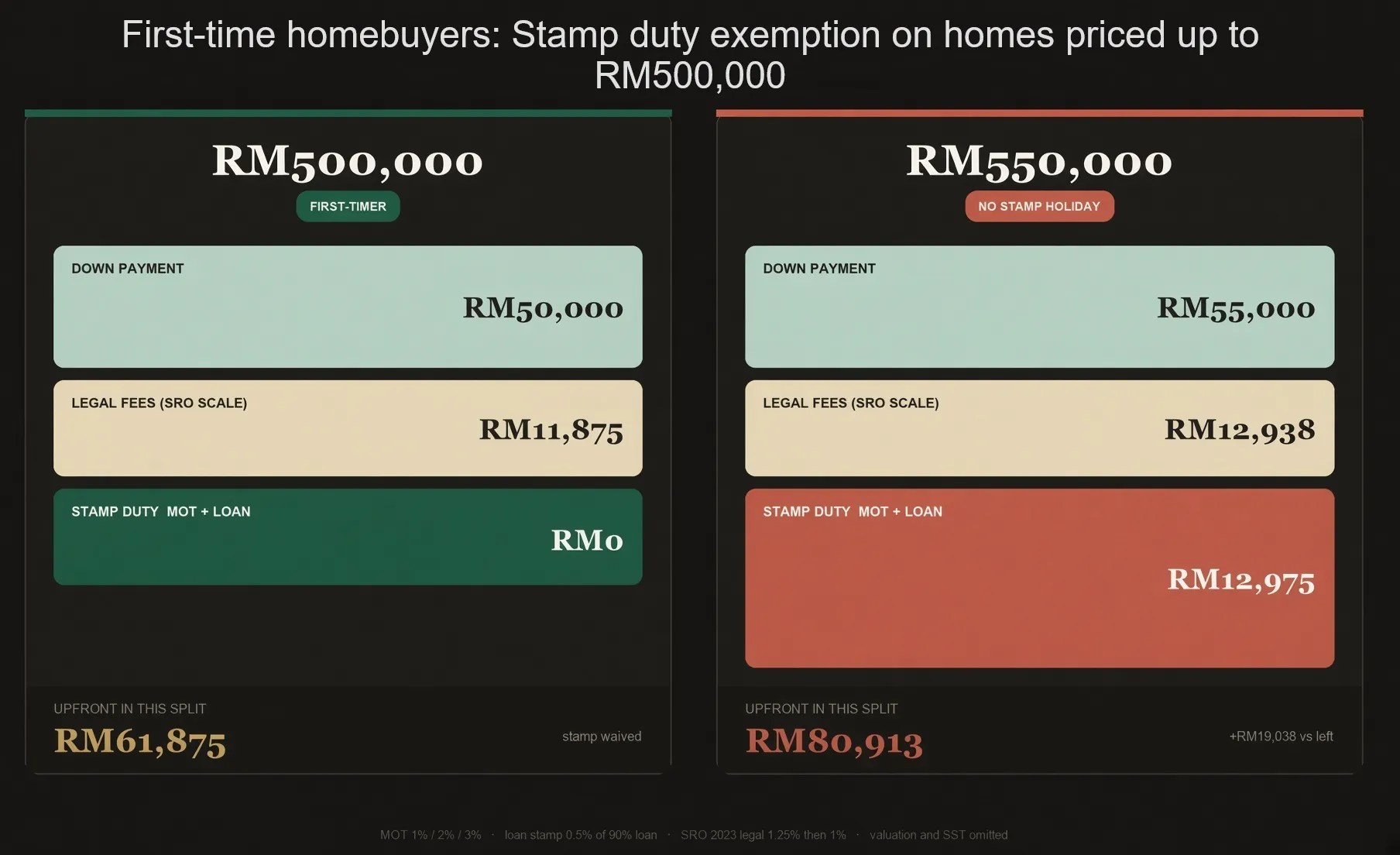
The real cliff is losing the exemption, not the extra 3% band. At RM500,001, a first-timer typically loses the whole waiver. At RM550,000, stamp duty is RM12,975 versus RM0 at the cap — RM12,975 more tax for a house that costs RM50,000 more.
RM500,000 · first-timer
RM0
MOT + loan stamp, if every eligibility box holds.
RM550,000 · same buyer
RM12,975
MOT RM10,500 + loan stamp RM2,475 on a 90% loan.
Legal fees:
Under SRO 2023 (from 15 July 2023), legal fees are 1.25% on the first RM500,000 of the SPA or loan, then 1% on the next RM7 million. On an RM500,000 SPA that is RM6,250. On an RM450,000 loan that is RM5,625. Together that is RM11,875 of scale fees before SST and disbursements — more than the stamp-duty saving.
Buying direct from a licensed developer can reduce HDA work by 25–50% on that scale. Some developers also absorb legal and stamp costs as a promotion. That is a commercial offer, not a right. SST on legal fees is quoted at 6% in one guide and 8% in another, so use the law firm’s quotation.
A Mock-up Scenario: What a first time home buyer actually pays
Here is a worked example for a Malaysian citizen buying a sub-sale at RM500,000 with a 90% loan. The figures follow StashAway’s July 2026 line-by-line table.
Down paymentStampLegal scaleValuation
| Line | Not first-timer | First-timer |
|---|---|---|
| 10% down | RM50,000 | RM50,000 |
| MOT stamp | RM9,000 | RM0 |
| Loan stamp | RM2,250 | RM0 |
| SPA legal (scale) | RM6,250 | RM6,250 |
| Loan legal (scale) | RM5,625 | RM5,625 |
| Valuation (their estimate) | RM1,500 | RM1,500 |
| Upfront in this table | RM74,625 | RM63,375 |
Stamp duty saved: RM11,250. Legal fees and valuation still come to about RM13,375. The exemption does not make the purchase cheap. It removes one tax.
SJKP and similar 110% products can, in theory, cover the down payment. One write-up describes SJKP at up to 110% with an income cap around RM11,000. Another describes Cagamas Skim Rumah Pertamaku with a tighter RM5,000 / RM10,000 cap. They are not the same product. Do not budget for a zero down payment until a participating bank confirms it in writing. Financing 110% also means you start with negative equity.
Hidden costs after the keys
These are the items that turn a comfortable instalment into a tight DSR.
- MRTA / MLTA. Not required by law, but lenders usually insist. As a rough illustration on an RM500,000 purchase: an MRTA lump sum of about RM17,500, or MLTA of about RM2,000 a year. If it is financed into the loan, the monthly instalment rises. Check with the service providers for details.
- Maintenance + sinking fund. Example: 900 sq ft at RM0.35 (hypothetical figure but close enough in average)psf is RM346.50 a month. Skip this and a “cheap” condo can still cost more than RM4,000 a year to run.
- Cukai pintu/Quit rent. Local council tax, usually twice a year. An example around RM1,200 a year, based on a RM2,000 monthly rental-value assumption.
- Renovation. A sub-sale may need RM20,000–50,000 (or more depending on the conditions) to be ‘liveable’ comfortably. A bare new unit can need RM30,000–80,000 for interior work. That is often when buyers take an 8–12% personal loan after the 10% and legal fees have already gone out.
On that 900 sq ft, RM500,000 serviced apartment, a first-timer is looking at about RM65,000–66,500 up front, then a monthly instalment of RM2,130 plus maintenance of RM346.50 — RM2,476.50 before assessment tax and insurance.
Agent commission is usually paid by the seller, up to 3% of the sale price. Sellers can include it in the asking price, so the buyer still bears it in the end.
For the longer “does buying actually win” question, we ran a 20-year Klang Valley condo comparison: Rent vs Buy KL Condo. The same idea, after costs: true property returns after costs and inflation.
New launch vs Sub-sale
Developer: You get a defect-liability period, a choice of unit, and sometimes absorbed fees — plus three to four years of waiting and the risk of delay or abandonment. Q1 2026 new-launch take-up was 11.5% (9,112 launched, 1,052 sold). The primary market is not automatically the easier path.
Sub-sale: You can see the actual unit and how the building is run. You also inherit defects, unauthorised extensions, and the seller’s existing charge. Confirm that an individual or strata title has been issued before treating ownership as clean.
Auction is a third market. It is usually a poor fit for a first home.
Mistakes that actually cost money!
- Signing the SPA before approval-in-principle.
- A booking form that forfeits the deposit if the bank declines the loan.
- Buying jointly with someone who already owns a home.
- Crossing RM500,001 for a slightly better unit and losing the stamp waiver.
- Paying without a contract. Upfront-payment scams still appear in PropertyGuru’s consumer guidance.
- Buying at about 70% DSR with no room for an OPR rise or another instalment.
In short. The practical sequence is DSR → approval-in-principle → search (stay at RM500k if you want the exemption) → booking with a clear refund clause → SPA → loan → stamp within 30 days → keys. The stamp holiday is real. It does not fix DSR. After the waiver, legal fees, the 10% and renovation are the cash you still need. Maintenance and MRTA are the monthly costs that follow.
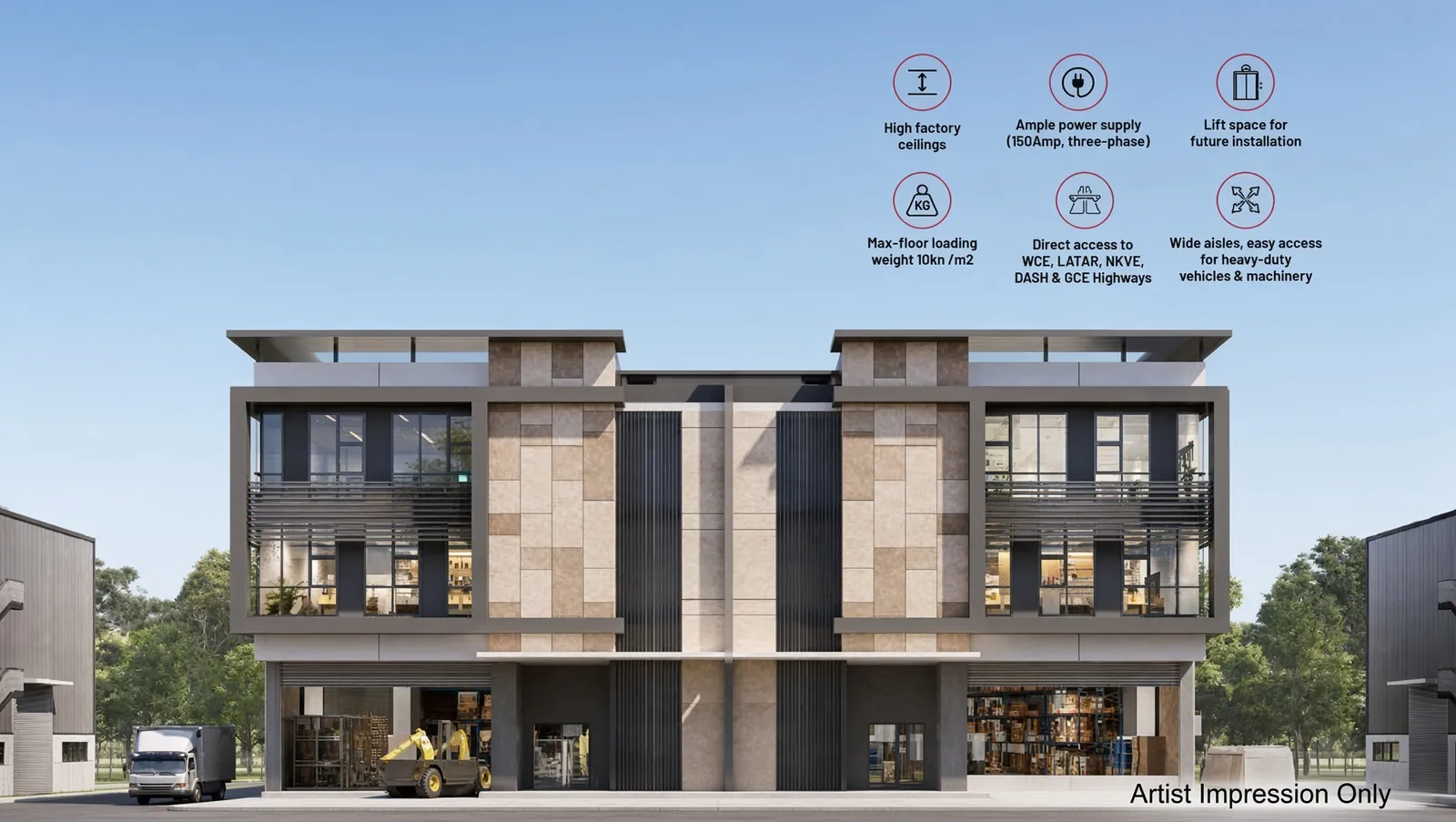
A factory or shop SPA does not get this exemption. If that is the next purchase, the process is different — and stamp duty is not RM0.
Numbers: Budget 2026 / PropertyGuru / IQI (exemption to 31 Dec 2027); StashAway 29 Jul 2026 (RM500k cash table); MahWengKwai (SRO 2023 scale); JPPH/EdgeProp Q1 2026 (11.5% take-up); REHDA via MyRumahBaru (72% financing); Focus Malaysia (≈40.6% approval). Confirm eligibility with a solicitor and LHDN.
Disclaimer. This article is for general information only. It is not legal, tax, banking or financial advice, and it is not an offer to buy, sell or finance any property. Figures are worked examples from published scales and third-party write-ups as of 2026; they can be wrong, rounded, or out of date. Stamp duty, legal fees, loan rules, DSR practice and exemptions can change without notice. Always verify eligibility, rates and cash with a licensed solicitor, LHDN and your bank before you sign or pay.



Leave a Reply