

We already did homes. In our 20-year rent vs buy analysis for a KL condo, we ran the numbers for people buying a place to live.
Factories play by different rules.
The buyer is usually a Sdn Bhd, not a person. There’s no first-home relief to soften the stamp duty. And both RPGT and tax treatment change, sometimes in your favour and sometimes not.
Rates matter too. The OPR has been 2.75% since the 9 Jul 2025 cut (BNM OPR decisions). The next MPC meeting is on 5 Nov 2026, the 6th and final meeting of 2026 (BNM MPC schedule). Recheck the OPR after 5 Nov.
So here’s the plan: real 2026 cost scales, a worked example and a checklist.
Why a factory isn’t a bigger house
The buyer is a company. That means company RPGT rates and corporate tax treatment apply, not the ones you know from buying a home.
The loan is priced differently. The SBR (Standardised Base Rate, the reference rate banks set for retail loans, linked to the OPR) applies only to retail (individual) loans. Company loans are priced off BR/BLR plus a spread, which is the extra margin the bank adds on top of the base rate to price your risk (Maybank rates).
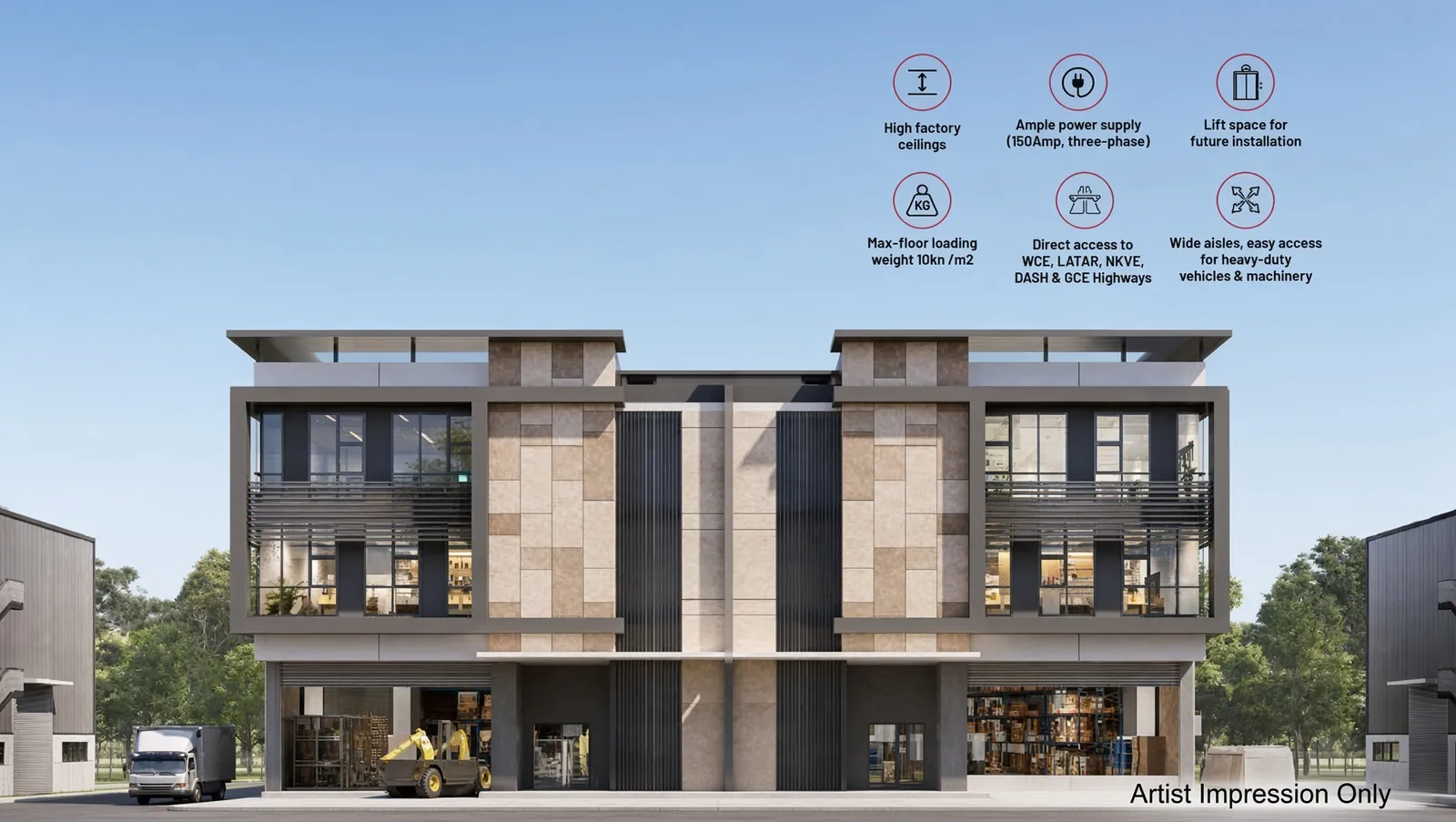
Spec beats looks. What matters is power (kW), ceiling height, loading bays and floor loading. A pretty unit that can’t take your machines is an expensive mistake.
Use and title must match. Your operation has to fit what the land title allows. More on that next.
| Item | Home | Factory |
|---|---|---|
| Buyer | A person buying a place to live | Usually a Sdn Bhd |
| Margin | Not covered in this article | Commonly 80%; some packages 85%, or 90% including fees |
| Stamp relief | First-home relief | None: no first-home relief |
| RPGT after 5 years | 0% from year 6 (individual citizen) | 10% from year 6 (company): never 0% |
| Tax deduction | Not covered in this article | Rent deductible (s.33(1)(b)); owners claim interest, IBA and capital allowances, nothing on land |
| Typical tenancy | Not covered in this article | Deposit typically 2+1 or 3+1 months; tenancy stamp duty RM1–RM7 per RM250 of annual rent |
Source: figures from this article (LHDN, The Edge, Maybank, CIMB). Home column limited to what this article covers.
Know what you’re buying: title, tenure and consent
Check the title before you argue about the price. A cheap factory on the wrong title isn’t cheap.
Light, medium and heavy industrial
The National Land Code has only three land-use categories: agriculture, building and industry (s.52, NLC, Act 828, Bar Council copy). “Light, medium and heavy” is a planning and state classification, not an NLC category.
The planning definitions rest on pollution and risk:
- Light: no or very low air, noise, vibration, odour and fire or explosion risk, and no hazardous raw materials. Minimum buffer 50 m.
- Medium: moderate pollution and risk, with mostly treatable scheduled waste. Minimum buffer 150 m.
- Heavy: high pollution and risk, large-scale raw materials and hard-to-treat waste. Minimum buffer 300 m.
Sources: MBJB industrial planning guideline, based on DOE siting guideline and the PLANMalaysia planning glossary. Check your own local plan (RT/RTD) and your local council.
The state prices these categories differently. In Selangor, the conversion premium is 20% (light), 25% (medium) or 30% (heavy) of the new land value (PTG Selangor).
Bottom line: your planned use must match the title’s category and the express condition on the title.
Freehold vs leasehold
For leasehold, check how many years are left. Banks may offer a lower margin or shorter tenure, or decline, when few lease years remain. Ask your bank before you sign.
Renewal is at the state’s discretion and costs a premium. Check with the state land office (PTG).
Consent to transfer and charge
The State Authority may alienate land subject to express conditions and restrictions in interest, endorsed on the title (NLC s.120, NLC, Act 828).
Many industrial titles carry a restriction requiring State Authority consent to transfer, charge or lease. Look for the “Sekatan Kepentingan” endorsement on the title.
Some industrial parks also require the park developer’s or state corporation’s consent. Your lawyer will confirm.
Consent takes time. Build it into your completion timeline.

What renting really costs
Rent levels and yields
Klang Valley semi-D factories yield about 5% on average, and larger properties 7% and above (The Edge). That article is old, though; it quotes 2016 data.
The fresher figure: prime industrial yields average 5–6% in 2026, tightest in the Klang Valley and Iskandar (Henry Butcher Malaysia, quoted in The Edge Industrial Market Insight, 29 Jun 2026).
For actual rents, Penang gives us sourced numbers. Monthly rents at 2Q2026 were RM2.50–4.50 psf in Bayan Lepas, RM1.80–3.50 psf in Batu Kawan and RM1.30–2.80 psf in Prai (The Edge | CBRE-WTW Industrial Property Monitor 2Q2026).
For the Klang Valley, Alan of Estate Market Pulse puts current market rents at about RM1.50–3.00 psf a month, depending on location, age and specs. (Figure is opinion.)
In the Klang Valley, rents vary widely by location, age and spec. Get two or three quotes for your area.
Upfront cash for a tenant
Deposit. Typically 2+1 or 3+1 months (security plus utility). That’s market practice, not law, so treat it as typical and negotiable.
Tenancy stamp duty. This changed. Under Stamp Act 1949 First Schedule Item 49(a), as amended by Finance Act 2024, for tenancies from 1 Jan 2025, you pay for every RM250 (or part) of average annual rent:
- RM1 for a term of up to 1 year
- RM3 for more than 1 and up to 3 years
- RM5 for more than 3 and up to 5 years
- RM7 for more than 5 years or an indefinite term
The RM2,400 exemption was removed from 1 Jan 2025, so duty is on the full annual rent (The Sun, Tax Matters; Finance Act 2024 s.27 on Laws of Malaysia Online).
Since 1 Jan 2026, tenancies are self-assessed and stamped via MyTax (STSDS Phase 1, LHDN). LHDN’s stamp duty hub: https://www.hasil.gov.my/en/duti-setem/
Fit-out. This is the one that bites. The tenant usually pays for M&E: power upgrades, racking, a mezzanine, the office. Then you pay again for reinstatement when you leave.
What rent buys you
Flexibility, cash that stays in the business, and zero price risk.
Supply may help too. About 7.2m sq ft of new Klang Valley warehouse supply is expected by end-2026, with occupancy at 96.1% in 1Q26 (CBRE-WTW 1Q 2026). More supply may give tenants more leverage.
| Item | What to budget |
|---|---|
| Deposit | Typically 2+1 or 3+1 months (security + utility); negotiable |
| Tenancy stamp duty | RM1 / RM3 / RM5 / RM7 per RM250 of annual rent, by term (from 1 Jan 2025); no RM2,400 exemption |
| Fit-out (M&E, power upgrade, racking, mezzanine, office) | Your own input: RM ______ |
| Reinstatement at exit | Your own input: RM ______ |
Source: Stamp Act 1949 Item 49(a) as amended by Finance Act 2024; deposit is market practice.
What buying really costs
Day-one cash
Your down payment is 100% minus the loan margin (see the next section). Then the fees stack up.
Stamp duty on the MOT. Tiered under Item 32(a): 1% on the first RM100k, 2% on the next RM400k, 3% on the next RM500k and 4% above RM1m. No first-home relief for a factory (Stamp Act 1949, LHDN copy as at 1 Jan 2024; LHDN stamp duty).
| Portion of price | Rate |
|---|---|
| First RM100,000 | 1% |
| Next RM400,000 | 2% |
| Next RM500,000 | 3% |
| Above RM1,000,000 | 4% |
Source: Stamp Act 1949 (LHDN copy as at 1 Jan 2024).
Stamp duty on the loan. Generally 0.5% of the loan (Item 27(a), same source). SME loans get concessionary tiered rates under Item 27(a)(i), so check with your lawyer.
Legal fees. Under SRO 2023: 1.25% on the first RM500k, 1% on the next RM7m, and negotiable above that. You pay them on both the SPA and the loan. SRO 2023 took effect on 15 Jul 2023 (Bar Council Circular 185/2023). Add 8% service tax on legal fees from 1 Mar 2024 (MySST Service Tax FAQ).
| Portion of price / loan | Scale fee |
|---|---|
| First RM500,000 | 1.25% |
| Next RM7,000,000 | 1% |
| Above RM7,500,000 | Negotiable |
| Service tax on legal fees (from 1 Mar 2024) | +8% |
Source: Bar Council Circular 185/2023 (SRO 2023, effective 15 Jul 2023); MySST Service Tax FAQ.
The rest. Valuation, disbursements and the consent fee.
Running costs of owning
Once it’s yours, so are the bills:
- Quit rent
- Assessment
- Fire insurance
- Repairs
- Maintenance charges for strata units
Building instead? Price it in our Buy Land to Build Your Factory – Cost Simulator. Land conversion, TNB, CIDB, SST and LAM fees are already covered there.
Financing and the rate risk
Margins of up to 80–90%
A margin of 80% is common (The Edge).
Some packages go higher. Maybank’s Maxi Plan offers “as high as 85%” (Maybank Maxi Plan). CIMB Business Premises Financing-i offers “up to 90% inclusive of MRTT / Legal fee / Valuation” (CIMB). Read that carefully: the 90% includes fees. It isn’t 90% of the price alone.
Older, short-lease or special-use buildings may get less. The bank’s valuation decides.
SME packages that bundle working capital go further still: Maybank Eco Leap offers “up to 150%” (Maybank Eco Leap). More debt means more rate sensitivity.
OPR and loan-rate context
The OPR went from 1.75% to 3.00% in five hikes between May 2022 and May 2023, then was cut to 2.75% in Jul 2025 (BNM).
At Maybank, BR is 2.75% and BLR is 6.40%, effective 11 Jul 2025 (Maybank).

Here’s the asymmetry. A floating loan reprices soon after an MPC move. Rent reprices only at renewal. Owners feel rate changes fast; renters feel them late.
If that worries you, fixed options exist. Maybank’s Maxi Plan quotes “as low as 5.20% for the first 3 years” (Maybank link above). See also the Public Bank SWIFT Plan.
How much does a rate move hurt? On RM1m over 25 years, the monthly instalment is:
- 4.5%: RM5,558
- 5.0%: RM5,846
- 5.5%: RM6,141
- 5.75%: RM6,291
Each +0.25% adds about RM143 a month per RM1m at 4.5% (RM5,558.32 to RM5,701.17, or +RM142.85). Note that 5.75% here is a bank loan rate for stress testing, not the OPR.
| Loan rate | Monthly instalment |
|---|---|
| 4.5% | RM5,558 |
| 5.0% | RM5,846 |
| 5.5% | RM6,141 |
| 5.75% | RM6,291 |
Source: Estate Market Pulse calculation. 5.75% is a bank loan rate for stress testing, not the OPR.
Tax: the part most owners skip
Renting: rent is deductible
Rent for business premises is deductible under ITA 1967 s.33(1)(b) (LHDN Acts).
Owning: interest, IBA and capital allowances
Interest. Loan interest on a business property is deductible (s.33(1)(a); LHDN Public Ruling 2/2011, Interest Expense).
Industrial Building Allowance. IBA is a tax allowance that lets you deduct part of what you spent on an industrial building from your taxable income, year by year. Land gets no allowance. A factory building may qualify for IBA (ITA Schedule 3, paras 12, 16 and 64): an initial 10% and an annual 3% of qualifying building expenditure. You must own the building and use it in your business as an industrial building (LHDN Public Ruling 3/2018). Warehouses get 10% annual with no initial allowance (para 37C, LHDN).
Capital allowances. Plant, machinery and M&E fit-out get an initial 20% plus an annual 14% (general plant), 20% (heavy machinery, vehicles) or 10% (office equipment, furniture) (LHDN capital allowance rates; qualifying plant: Public Ruling 12/2014).
Tenants doing fit-out: the treatment (renovation vs plant) differs. Ask an accountant.
RPGT when you sell
This is where companies and individuals part ways (LHDN RPGT rates):
- Years 1–3: 30% (company) / 30% (individual citizen)
- Year 4: 20% / 20%
- Year 5: 15% / 15%
- Year 6 onwards: 10% / 0%
A company never reaches 0%.
| Holding period | Company | Individual citizen |
|---|---|---|
| Years 1–3 | 30% | 30% |
| Year 4 | 20% | 20% |
| Year 5 | 15% | 15% |
| Year 6 onwards | 10% | 0% |
Source: LHDN RPGT rates.
And no, a share sale isn’t a clean escape. Since 1 Jan 2024, companies selling shares in a real property company are generally taxed under CGT (PwC; Deloitte 2026).

Worked example: a FICTIONAL semi-D in Selangor
FICTIONAL. Illustration only. Not a listing or market quote.
The case: a 2-storey semi-D factory, medium industrial. Land 20,000 sf, built-up 11,400 sf. Price RM5m. Rent RM25k a month (RM2.19 psf; 6.0% gross).
The loan: 80%, so RM4m over 25 years. Base rate 4.5%, stress rate 5.75%.
Day one
The buyer needs RM1,000,000 down, plus RM184,000 MOT duty, RM20,000 loan duty and RM99,900 in legal fees and SST. That’s ≈RM1.30m.
Duty and fees alone come to about 6.1% of the price. Not the “4–5%” people like to quote.
The renter needs a RM100,000 deposit plus RM3,600 duty (3-year term, 2025 scale). That’s RM103,600.
| Item | Buyer (RM) | Renter (RM) |
|---|---|---|
| Down payment / deposit | 1,000,000 | 100,000 |
| MOT stamp duty / tenancy duty (3-year term) | 184,000 | 3,600 |
| Loan stamp duty | 20,000 | – |
| Legal fees and SST | 99,900 | – |
| Total day one | ≈1,300,000 | 103,600 |
FICTIONAL illustration only. Not a listing or market quote.
Month by month
At 4.5%, the instalment is RM22,233, which is RM2,767 below rent. At 5.75%, it’s RM25,164, which is RM164 above rent. The instalment equals rent at ≈5.68%.
When does buying win?
Buying wins after about 8 years at 4.5%. At 5.75%, it takes about 14 years.

A rate that’s 1.25 points higher nearly doubles the wait.
Caveats: this assumes a flat price and flat rent. Growth in either pulls the breakeven earlier. Running costs push it later.
Flexibility vs equity
Renting buys agility. You can scale up or down, relocate with your contracts, and keep capital out of bricks.
Owning buys control. You control the fit-out, your occupancy cost is stable, you build equity, and you have an asset to borrow against. The price: cash locked in and a harder exit.
Don’t forget opportunity cost. In our fictional case, RM1.3m earning 6.5% (the simulator default) is ≈RM85k a year. That’s money the deposit isn’t making.

Decision checklist
Before you sign, tick these off:
- Staying 6+ years? Has the breakeven been tested?
- Down payment + ~6% duty/fees without starving working capital?
- Can you survive a +1% rate rise for 12 months?
- Does the title category and express condition match your use?
- Freehold, or how many lease years left? Is consent needed and how long will it take?
- Power, ceiling, loading and floor load fit for 10 years?
- Two bank offers compared (margin, spread, fixed vs floating, lock-in)?
- Renter leverage checked (supply, renewal option, rent cap)?
- Accountant consulted on IBA, CA, rent deduction and RPGT?

So, buy or rent?
Rent if you’re growing fast, your contracts are uncertain, cash is tight, or you can’t commit for the long haul. In our fictional case, buying only pulled ahead after about 8 years at 4.5%, and 14 at 5.75%. Your break-even will move with rates, rents and prices, so run your own numbers.
Buy if your space needs are stable, you’ll stay long, you can absorb rate shocks, and the title fits your use.
Neither is the “grown-up” choice. Your own numbers decide, so run the simulators.
Key takeaways
- A factory isn’t a home: no stamp relief, and company RPGT never drops below 10%.
- Day one: buying needs ~25–30% of the price in cash (fictional case); renting needs a few months’ rent plus fit-out.
- Rates hit owners fast and renters slowly.
- Tax: rent is fully deductible; owners claim interest, IBA and capital allowances, but land gets no allowance.
- Check the title (category, tenure, consent) before you negotiate the price.
FAQ
Is it cheaper to rent or buy a factory in Malaysia?
It depends on how long you stay, your loan rate and the opportunity cost of your cash. Test your own numbers in the Rent vs Buy Shop/Factory Simulator.
What loan margin can I get for a factory?
Commonly 80% (The Edge). Some packages go to 85% (Maybank Maxi Plan) or 90% including fees (CIMB).
How much stamp duty do I pay on a factory?
MOT duty is tiered at 1–4%, plus generally 0.5% on the loan (Stamp Act 1949, LHDN).
What’s the stamp duty on a factory tenancy?
Since 1 Jan 2025: RM1, RM3, RM5 or RM7 per RM250 of annual rent, depending on the term. It’s charged on the full rent, with no RM2,400 exemption (Item 49(a); The Sun).
Do companies pay RPGT after 5 years?
Yes, 10% from year 6 (LHDN).
Can I claim tax allowances on a factory I own?
Yes: IBA (10% initial + 3% annual) on the building and capital allowances on plant, but nothing on land (LHDN PR 3/2018).
What’s the difference between light, medium and heavy industrial?
The level of impact: pollution and risk. The conversion premium differs too (PTG Selangor).
Freehold or leasehold factory?
Check the remaining lease years and any restriction in interest that needs state consent (NLC s.120). Banks may be stricter on short leases, so ask yours.
Try it with your own numbers
Run your own numbers, free. Start with the Rent vs Buy simulator. Thinking of building? Price it with the Build Cost Simulator.
Want a second pair of eyes on a Klang Valley factory, shoplot or industrial land? Talk to Alan directly for commercial terms: WhatsApp, email, or FB @estatemarketpulse.
† assumptions. Confirm with your bank, lawyer or tax adviser. Not financial, tax or legal advice. The semi-D example is fictional.

Leave a Reply